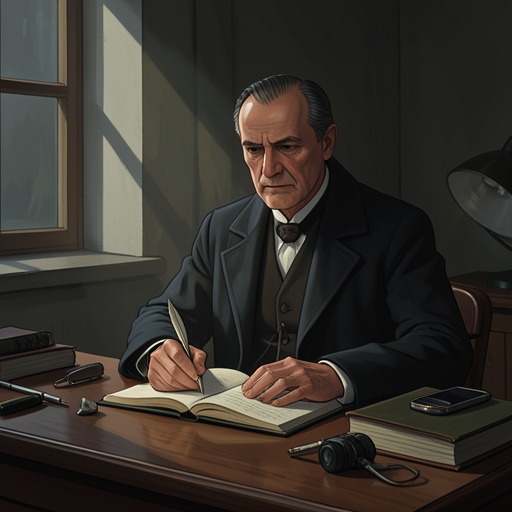
1899 framing the inquiry
The Book’s Founding Claim
[Freud](entity:character-recall-character-freud-0bf509d8fee9) opens by arguing that dreams are meaningful psychical formations rather than meaningless by-products of sleep. A method of interpretation, he promises, can connect a dream to waking life and expose the forces shaping it.
He situates the project within earlier writing on dreams, noting the long-standing disagreement between supernatural explanations and physiological or psychological ones. His own inquiry will concentrate on psychology, while treating the established literature as a starting point rather than a solution.
At the beginning of Chapter I
The Dream’s Tie to Waking Life
[Freud](entity:character-recall-character-freud-0bf509d8fee9) reviews opposing accounts of whether dreams detach sleepers from ordinary life or continue its concerns. Writers such as Burdach stress the dream’s apparent separation from waking experience; others insist that recent events and interests reappear in it.
He concludes that both impressions contain part of the truth: dreams seem strange and self-contained, yet their material comes from experience. The contradiction becomes a guiding problem for his later argument about how waking thoughts are transformed in dreams.
Early in Chapter I
Forgotten Memories in Dreams
[Freud](entity:character-recall-character-freud-0bf509d8fee9) surveys reports of dreams that revive knowledge unavailable to the waking dreamer. An old plant name, a forgotten encounter, or an obscure childhood scene may return in a dream and later be verified through a book, another person, or a recovered memory.
These cases, he argues, show that memory retains far more than waking consciousness can retrieve. Dreams also select trivial and remote details, a pattern that conventional theories struggle to explain and that Freud will later connect to the dream-work.
Early in Chapter I
External Stimuli Become Dream Scenes
[Freud](entity:character-recall-character-freud-0bf509d8fee9) examines how sounds, light, pressure, temperature, and other bodily sensations can enter dreams. A ringing alarm becomes a church bell or a sleigh; a fallen bedboard becomes the blade in a dream of execution.
Such examples establish that outside stimuli can shape a dream, but they do not explain why the same stimulus produces different stories. Freud challenges accounts that make the stimulus alone responsible and prepares to argue that psychical motives determine how it is interpreted.
Later in Chapter I
Theories of Dreaming Surveyed
[Freud](entity:character-recall-character-freud-0bf509d8fee9) organizes earlier theories by the role they assign to mental activity during sleep: some treat dreaming as nearly normal thought, others as diminished or fragmented thought, and still others as a special creative activity of the psyche. He reviews proposals that dreams discharge trivial impressions or use bodily sensations as symbols.
He finds useful observations in these accounts but rejects their failure to explain the dream as a meaningful psychical act. The survey ends with the unresolved kinship between dreams and mental illness, a comparison he will revisit through his own interpretive method.
At the start of Chapter II
Free Association as Method
[Freud](entity:character-recall-character-freud-0bf509d8fee9) rejects both whole-dream symbolic interpretation and fixed-key dream dictionaries. Instead, he proposes treating each element separately and asking what thoughts arise when the dreamer abandons deliberate criticism.
The method grows out of his work with neurotic symptoms: patients’ spontaneous thoughts can lead from a symptom back to the experiences and conflicts that formed it. Freud now applies the same procedure to dreams, treating them as psychical formations whose meaning must be discovered rather than assigned in advance.
Night of 23–24 July 1895
The Irma Injection Dream
After a difficult treatment ends without fully curing [Irma](entity:character-recall-character-irma-278cf6262b39), [Freud](entity:character-recall-character-freud-0bf509d8fee9) hears from his colleague [Otto](entity:character-recall-character-otto-b03057fe2235) that she is better but not recovered. Annoyed by what sounds like criticism, Freud writes her clinical history that evening; during the night he dreams that Irma complains of pain and choking, and that several doctors examine her and discover an infection.
The dream shifts blame away from Freud: Irma’s condition is attributed in turn to her own resistance, an organic illness, Otto’s careless injection, and an unclean syringe. Its contradictory explanations form a defensive case for Freud’s innocence, while the dream’s medical details draw on recent conversations, professional anxieties, and memories of earlier clinical mistakes.
After the Irma dream
The Dream as Wish-Fulfilment
[Freud](entity:character-recall-character-freud-0bf509d8fee9) concludes that the [Irma](entity:character-recall-character-irma-278cf6262b39) dream fulfills his wish to be cleared of responsibility for his patient’s suffering. His colleagues and patient are made to bear blame, while the dream turns Freud’s embarrassment and professional anxiety into a vindicating fantasy.
He generalizes from this case: the dream is not random noise but a meaningful psychical act, constructed through elaborate work. The discovery opens a new question—whether every dream fulfills a wish, even when its remembered content seems unpleasant or nonsensical.
Freud’s adult life
Simple Dreams of Thirst
[Freud](entity:character-recall-character-freud-0bf509d8fee9) describes recurring dreams in which, after eating salty food, he dreams of drinking and wakes thirsty. In one variation, an inaccessible glass is replaced by a vessel offered by his wife, but the water tastes too salty to satisfy him.
These dreams reveal an uncomplicated wish-fulfilment, while also showing that dreaming can preserve sleep by imagining satisfaction instead of waking the sleeper. Freud uses them as clear evidence before turning to less transparent adult dreams.
Freud’s children’s early childhood
Children’s Wishes Fulfilled
[Freud](entity:character-recall-character-freud-0bf509d8fee9) recounts children’s dreams that directly repair small disappointments: a boy dreams of reaching the mountain lodge he was denied, a girl dreams of being adopted into a family with a boy she likes and receiving chocolate, and a toddler dreams aloud of foods withheld after illness.
The dreams’ plainness makes them valuable evidence. Children have not yet acquired the same degree of censorship and distortion as adults, so their dreams show the wish and its fulfillment with unusual clarity.
After the initial examples
Distortion Hides Unwelcome Wishes
[Freud](entity:character-recall-character-freud-0bf509d8fee9) confronts dreams whose manifest content is distressing or appears to frustrate a wish. He argues that the remembered dream is not the whole story: analysis may reveal a latent wish concealed beneath an unpleasant scene.
In the dream of a failed dinner party, a woman’s apparent frustration expresses hostility toward a rival who wants to gain weight and attract her husband. Another patient dreams of an unwanted trip with her mother-in-law because she wants Freud’s theory to be wrong; a young woman’s dream of a dead child masks a desire to see a beloved man again.
During Freud’s clinical work
The Arrest and Infanticide Dream
A jurist dreams that he is arrested for infanticide after spending the night with a married woman and worrying that contraception may have failed. [Freud](entity:character-recall-character-freud-0bf509d8fee9) interprets the dream as a wish for reassurance that no child has been conceived, expressed in the disturbing form of having killed one.
The dream shows how an apparently punitive or frightening scenario can fulfill a wish while disguising it. Freud formulates his revised claim: the dream is the disguised fulfillment of a suppressed or repressed wish.
Spring 1897 and the following morning
Freud Dreams of Promotion
After learning that two professors have proposed him for promotion, [Freud](entity:character-recall-character-freud-0bf509d8fee9) doubts that the appointment will succeed; anti-Semitic considerations have blocked colleagues in similar circumstances. The next morning he dreams that his friend R. is his uncle Josef, a man once imprisoned for handling forged banknotes, and feels exaggerated affection for him.
Analysis reveals a wish to separate Freud’s prospects from the disqualifying traits assigned to his colleagues. The dream also exposes its censorship: tender affection conceals an insulting judgment, showing how a dream can express a thought by staging its opposite.
Early March 1898
The Botanical Monograph Dream
[Freud](entity:character-recall-character-freud-0bf509d8fee9) dreams that he has written a botanical monograph, opens a colored plate, and finds a dried plant specimen attached to it. A bookshop display of a monograph on cyclamen supplies the obvious recent impression, but analysis links the dream to his wife’s favorite flower, his cocaine research, his professional ambition, and a childhood memory of tearing a book apart.
The dream’s trivial surface element acts as a proxy for more significant thoughts about recognition, work, and the cost of Freud’s hobbies. Its many associations demonstrate how a single image can condense several lines of thought.
Late 1890s
The Rome Dreams
[Freud](entity:character-recall-character-freud-0bf509d8fee9) repeatedly dreams of approaching or reaching [Rome](entity:location-recall-location-rome-3ec0a741c1f4), a city he longs to visit but cannot yet bring himself to enter. The dream images substitute familiar places and landscapes for the unseen city, while associations connect Rome to the [Catholic Church](entity:organization-recall-organization-catholic-church-7dfe4f6d7f50), anti-Semitism, his father’s humiliation, and his identification with [Hannibal](entity:character-recall-character-3c1d42922798).
The repeated dreams turn travel into a disguise for larger wishes and conflicts. Freud later interprets his eventual visit to Rome in 1901 as the overcoming of an inhibition worked through during the writing of the book.
Chapter VI
The Dream-Work Defined
[Freud](entity:character-recall-character-freud-0bf509d8fee9) compares manifest dream content to a rebus: its images must be read as signs for underlying thoughts rather than judged as a literal picture. He identifies condensation, displacement, representability, and secondary revision as the principal operations transforming latent dream-thoughts into the remembered dream.
A botanical monograph dream shows how a few visible elements can represent a vast network of associations. The dream’s apparent brevity and oddity arise from the work of compression and distortion, not from a lack of meaning.
During Freud’s clinical work
The Pleasant Dream of Sappho
A patient dreams of a theatrical outing, a difficult climb, and a return to town. [Freud](entity:character-recall-character-freud-0bf509d8fee9) links the changing effort of the ascent to a recently ended love affair and to the plot of Daudet’s Sappho, then traces the dream’s images to the patient’s childhood nurse and fantasies about social position and sexuality.
The dream’s disparate elements overlap through shared associations, illustrating both condensation and displacement. Its seeming travel narrative conceals a conflict about desire, class, and the burden of an intimate relationship.
During a woman patient’s analysis
The May Beetles Dream
A woman dreams of two beetles in a box: one escapes, while the other is crushed as the window closes. Her associations include childhood cruelty to insects, a recent moth trapped in a glass, her anxiety about her absent husband, and memories of sexual desire and marriage.
[Freud](entity:character-recall-character-freud-0bf509d8fee9) interprets the beetles through the patient’s associations to cantharides, an aphrodisiac made from beetles, and to her wish for her husband’s renewed sexual potency. The unsettling dream combines desire and fear in a compressed, heavily disguised form.
Across the dream analyses
Words and Numbers in Dreams
[Freud](entity:character-recall-character-freud-0bf509d8fee9) shows how names, puns, fragments of speech, and calculations become material for dream construction. A patient’s invented word combines scraps of conversation; numbers in other dreams disguise ages, dates, money, and anxieties about marriage or professional standing.
These examples challenge the idea that dreams reason badly in a simple sense. Their speech and arithmetic are assembled from remembered material and transformed to serve the dream’s expressive and censoring purposes.
After news of Fl.’s operation
The Dream of Non Vixit
Worried about his friend Fl.’s health and hurt by a warning not to reveal private news, [Freud](entity:character-recall-character-freud-0bf509d8fee9) dreams that he confronts dead colleagues and says “[Non vixit](entity:expression-recall-expression-non-vixit-95f06d39f379).” In the dream, he seems to annihilate a rival with a look, while also raising a memorial to a friend.
Analysis uncovers several sources of feeling: fear of arriving too late, resentment at an implied rebuke, childhood rivalry with his nephew John, and ambition for professional advancement. The dream’s tenderness and hostility coexist, with its words and substitutions concealing the conflict.
Later in Chapter VI
Absurdity as Mockery
[Freud](entity:character-recall-character-freud-0bf509d8fee9) analyzes dreams that look absurd, including one that has his dead father take part in Hungarian politics and another that confuses travel by carriage and railway. In each case, nonsense turns out to be a means of expressing mockery or contradiction that could not appear directly.
He argues that absurdity is not evidence of a mind reduced to chaos. It can be a deliberate product of the dream-work, using distortion to protect forbidden criticism and to satisfy the censorship.
End of Chapter VI
Secondary Revision Shapes the Dream
[Freud](entity:character-recall-character-freud-0bf509d8fee9) identifies a final shaping force that tries to make the dream coherent and intelligible. It links fragments, smooths gaps, and may turn a dream into something like a plausible story, even though this apparent order can obscure the underlying thoughts.
The same imaginative activity appears in daydreams, which are wish-fulfilling fantasies built from memories and reshaped by desire. Freud distinguishes this revision from the more fundamental operations of condensation, displacement, and representability.
The night after the child’s death
The Burning Child Dream
A father keeps watch over his dead child, then lies down in a nearby room while an attendant guards the body by candlelight. He dreams that the child stands beside him and reproaches him for failing to see that it is burning; waking, he discovers that a fallen candle has scorched the shroud and the child’s arm.
The dream draws on an actual light and the father’s fear that the attendant has failed, but it also grants a moment of renewed life with the child. [Freud](entity:character-recall-character-freud-0bf509d8fee9) treats it as a compromise: the dream fulfills the wish to see the child alive while delaying the painful awakening.
At the start of Chapter VII
Forgetting and Recovering Dreams
[Freud](entity:character-recall-character-freud-0bf509d8fee9) addresses the objection that dreams cannot be interpreted reliably because memory alters or loses them. He argues that omissions, changed wording, and doubts are themselves shaped by resistance and may point toward the dream’s most vulnerable elements.
In analysis, forgotten passages sometimes return once resistance has been overcome. Freud concludes that dream memory is imperfect but not arbitrary: the changes made while recounting a dream remain associated with the thoughts they conceal.
Chapter VII, after the discussion of forgetting
Regression in Dreaming
[Freud](entity:character-recall-character-freud-0bf509d8fee9) proposes a schematic psychical apparatus with perceptual, memory, unconscious, and preconscious systems. In waking thought, excitation moves toward action; in dreams, it travels backward toward perception, transforming thoughts into vivid images.
He calls this reversal regression. The theory explains why dreams dramatize thoughts as immediate scenes and why logical relations are often lost, while allowing childhood memories and sensory traces to attract dream-thoughts into visual form.
Chapter VII, on wish-fulfilment
The Dream as Wish-Driven
[Freud](entity:character-recall-character-freud-0bf509d8fee9) distinguishes wishes that arise during the day from suppressed wishes that persist unconsciously and from bodily needs activated during sleep. He argues that a conscious concern can initiate a dream only when an unconscious wish supplies the force that allows it to form.
The day’s concerns provide material and a point of attachment, but an unconscious wish acts as the dream’s driving energy. In Freud’s account, the dream does not merely continue waking thought: it transforms and recruits that thought to serve wish-fulfilment.
Later in Chapter VII
The Dream Guards Sleep
[Freud](entity:character-recall-character-freud-0bf509d8fee9) argues that dreams respond to outside stimuli by ignoring them, denying them, or weaving them into a wished-for situation that allows sleep to continue. A student awakened by a landlady dreams he is already in the hospital and therefore need not get up; a painful stimulus can likewise be countered by a dream that denies the pain.
[Dreaming](entity:state-recall-state-dreaming-6d4dba0851f0) thus becomes the guardian of sleep rather than its enemy. It binds unconscious excitation and accommodates disturbances when possible, while waking occurs when a dream can no longer preserve the sleeper’s repose.
Near the end of the discussion of dream function
Anxiety Dreams and Repression
[Freud](entity:character-recall-character-freud-0bf509d8fee9) distinguishes anxiety arising from sexual excitation and repression from anxiety caused by bodily conditions. In some cases, anxiety is the transformed affect of a suppressed wish; in others, bodily anxiety helps shape the dream’s content.
He interprets frightening dreams as border cases in which the dream’s compromise fails: the unconscious wish pushes toward expression, but the resulting anxiety overwhelms the sleep-preserving function. His examples of childhood nightmares connect fear to sexual curiosity and forbidden impulses.
Later in Chapter VII
Primary and Secondary Processes
[Freud](entity:character-recall-character-freud-0bf509d8fee9) distinguishes the primary process, which seeks immediate satisfaction and permits condensation, displacement, and illogical combinations, from the secondary process, which tests thought against reality and inhibits unpleasure. The primary mode is present from the beginning of life; the secondary develops gradually.
[Repression](entity:concept-recall-concept-repression-b32701b9a24c) occurs when an infantile wish conflicts with later aims and is kept from conscious thought. Dreams reveal that this suppressed material remains active, capable of influencing ordinary mental life as well as neurotic symptoms.
The final section of Chapter VII
Consciousness and the Unconscious
[Freud](entity:character-recall-character-freud-0bf509d8fee9) concludes that consciousness is not the whole of the psyche but a sensory system that registers selected qualities of mental activity. [The unconscious](entity:concept-recall-concept-the-unconscious-eb13e82ea41f) is the broader basis of psychic life, while preconscious thoughts can reach awareness under conditions shaped by censorship and attention.
He argues that dreams offer a route into this hidden structure and that unconscious wishes, though not identical to conscious intentions, remain psychically real. The book closes by returning dreams to the past: they may picture a future, but that future is shaped by wishes rooted in earlier life.